How to Reduce Operating Costs in Your Foodservice Operation
Running a restaurant has never been a high margin business. The gap between a profitable month and a costly one feels narrower than ever right now. Food costs are up. Labor is harder to manage. The pressure to deliver consistent quality every service period does not let up regardless of what is happening on the cost side of the ledger. Reducing foodservice operating costs is one of the most pressing challenges owners and kitchen managers face, and the question is not whether to cut costs but where to find savings that actually hold without compromising the food or burning out the team.
This article covers the areas where restaurants tend to lose the most money and what you can do about it. Some of it comes down to operational discipline around food, inventory, and scheduling. Some of it comes down to having the right equipment in place so that what you produce actually reaches the guest in the condition you intended.
Controlling Food Cost Starts Before the Guest Ever Sits Down
Where the Losses Actually Come From
Food cost is one of the largest expenses in any restaurant operation and one of the most direct drivers of operating costs overall. It is also one of the hardest to control because the losses do not always show up in an obvious place. Over-prepping is one source, producing more than you sell and discarding the difference at the end of service. Temperature inconsistency during holding is another, where uneven heat causes part of a batch to dry out or drop below safe serving quality before it reaches a plate. Shrinkage is the third, particularly in proteins. Poor holding conditions can mean losing a meaningful percentage of your yield on every cook.
These losses are not small. A kitchen losing even a modest amount of yield on proteins each night absorbs that cost across every cover, every shift, every week. Over a full year it becomes a leak that never shows on a single P&L line but consistently works against your margins.
How Holding Equipment Affects Food Cost
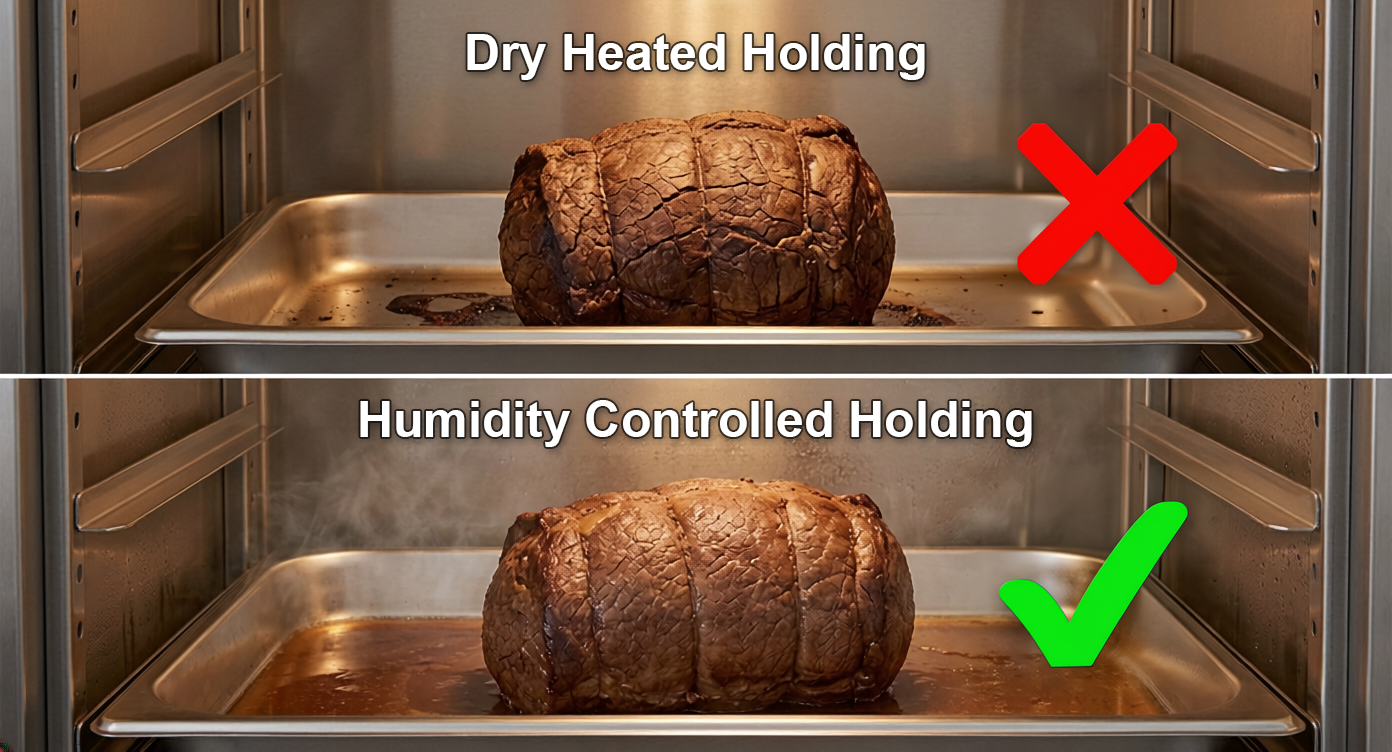 Controlling food cost loss at the holding stage means controlling the moisture environment food sits in between the cook and the pass. Not all holding equipment handles moisture the same way. For applications where shrinkage is a real concern, the type of heat system in your cabinet matters significantly.
Dry heat holding accelerates moisture loss. Proteins, vegetables, and dishes where texture and juiciness matter all suffer in a dry holding environment. Humidity controlled holding addresses that directly. These systems circulate hot moist air throughout the cabinet, reduce uneven temperature distribution, and help food stay at serving quality for longer holds.
Active climate control systems go further. They maintain specific heat and humidity conditions for different menu items and hold those conditions consistently even through repeated door openings during a busy service. FWE’s Humi-Temp® and Clymate IQ® systems deliver exactly these outcomes. For a full comparison of how different heat systems work and which applications each suits best, that is covered here.
Cook and Hold as a Food Cost Strategy

LCH-LV-SK-G2 Series
Cook and hold ovens address shrinkage from a different angle. Rather than cooking in large batches that sit under lamps, these ovens use low temperature cooking over a longer window. The result is more consistent yield with less shrinkage. Food then holds at the right temperature and humidity until service needs it.
For high volume operations running proteins through a busy service, the yield and consistency gains from a cook and hold approach are measurable in both food cost and plate quality.
See for yourself by using our Cook & Hold Yield Calculator to see potential cost savings!
How to Reduce Labor Costs Without Cutting Corners
Where Labor Costs Quietly Add Up
Labor pressure does not respond well to simply cutting hours or adding headcount. Real leverage comes from how efficiently your team executes during service. It also comes from how quickly new staff become productive and how little of the day gets spent on work that exists because a process is not doing its job.
Batch Cooking and Prep Scheduling
Batch cooking and prep scheduling offer two of the highest returns available to any restaurant. Kitchens that cook to order for everything put enormous pressure on the line during peak service. That pressure creates inconsistency. Inconsistency leads to remakes. Remakes are expensive because you pay twice for the same plate, once for the food and once for the time.
Building a production schedule around batch cooking smooths out the labor load and reduces skill dependency on the line when it counts most. Walking into service with proteins already cooked and held correctly means fewer high-pressure decisions at the worst possible moment. Fewer decisions under pressure produces fewer errors, fewer remakes, and a team that sustains pace across a full service.
Cook and hold ovens support this workflow directly. Production happens during slower prep periods when staffing costs are lower. The line during service executes rather than cooks from scratch under pressure. For newer staff, that distinction matters especially. A cook and hold approach is more forgiving and more repeatable than high heat cooking to order. Onboarding time shortens and the margin for error shrinks.
Equipment and Training Efficiency
Intuitive equipment also reduces the training burden. When holding cabinets and transport equipment are simple to operate and consistent in performance, new staff can focus on service rather than learning equipment quirks. That is a small advantage on any given day. Across a year of turnover, it adds up. Standardized equipment also helps managers build more repeatable workflows across shifts and locations. When the process is easier to teach and easier to repeat, training becomes more efficient and daily execution becomes more consistent.
Menu and Inventory Discipline
Simplifying the Menu
From The Bear, Season 3 — sometimes the best move is subtraction.
Some cost control requires no new equipment and no staffing changes. Tight menu and inventory discipline can have a meaningful impact on operating costs with nothing more than honest attention to what is on your menu and what is sitting in your walk-in. Most kitchens leaking money through food cost are doing it partly because the menu has grown beyond what the operation executes efficiently.
Menu simplification is one of the most effective and most resisted cost reduction moves in the restaurant industry. Every item that shares no ingredients with anything else is a liability. It demands dedicated inventory, dedicated prep, and dedicated training. Auditing your menu for ingredient overlap is worth doing regularly.
Dishes that draw from the same proteins, produce, and pantry staples as several other items are easier to prep, easier to hold, and easier to manage from an ordering standpoint. Dishes that require unique ingredients and complex preparation for modest sales volume deserve serious scrutiny, regardless of how attached anyone on the team is to them.
Menu discipline is one side of the margin equation. Inventory discipline is the other.
Inventory Management Basics That Actually Get Skipped
A consistent ordering system built around actual sales data reduces both over-ordering and the spoilage that follows. FIFO rotation, or first in first out, sounds obvious. In busy kitchens it breaks down constantly. The cost shows up in product pushed to the back and discovered too late.
Daily spot checks on high cost items, particularly proteins and specialty ingredients, create accountability. They catch shrinkage before it becomes a pattern. Knowing exactly what you have and using it in the right order is not exciting work. It is some of the most financially meaningful work happening in your kitchen.
Energy and Equipment: Two More Operating Cost Levers
The Utility Bill as a Cost Control Lever
Utility costs sit quietly in the background of most restaurant budgets. They are rarely the first thing operators think about when margins get tight, yet Utility costs are one of the areas where money leaks out in easily fixable ways.
Commercial kitchens run equipment hard and for long hours. The gap between efficient equipment and inefficient equipment does not show up once on a bill. It accumulates month after month across every piece of equipment running in your kitchen.
ENERGY STAR and What It Actually Means for Your Bills
ENERGY STAR certified foodservice equipment meets tested efficiency standards. Those standards translate directly into lower electricity or gas consumption compared to non-ENERGY STAR certified alternatives. For holding equipment, which runs continuously through every service period and often overnight, the difference between a certified and non-certified cabinet is not a rounding error. Over a full year of operation it is a real and recurring cost that impacts your bottom line whether you are tracking it or not.
For operators spec’ing new equipment, energy efficiency can be part of the purchasing decision from the start rather than an afterthought. FWE carries ENERGY STAR certified models across several product categories for exactly that reason.
The Real Cost of the Wrong Equipment
Purchase price is only the beginning of the cost story. Equipment not suited to its application costs money in ways that never appear on the original invoice. There is the energy cost of running something that works harder than it should. There is the food cost of product that does not hold properly. There is the labor cost of working around a unit that is not performing.
A lot of that hidden cost comes down to how the cabinet is built. Insulation is a good example — not just how thick it is, but where it is placed throughout the unit. Some manufacturers insulate only where required, leaving areas of the cabinet vulnerable to constant heat loss. Door gasket quality matters for the same reason. A poor gasket allows heat to transfer through the seal from the interior of the cabinet to the kitchen environment outside, forcing the cabinet to work harder around the clock to maintain set conditions.
FWE units are built with a focus on insulation and gasket seals, with insulation included in areas where others typically leave it out and ensuring every gasket seal is seated properly before leaving our factory. That translates directly to a cabinet that runs more efficiently, holds more consistently, and costs less to operate over its lifetime. Several FWE models carry Energy Star certification reflecting that overall design quality. Together, those factors make a higher quality cabinet that almost always lowers the cost over the life of the unit. That lower cost over the lifetime of a unit is the calculation worth making before the invoice is signed, not after.
Small Gains Add Up
Reducing operating costs rarely comes from one big fix. Food cost, labor efficiency, menu discipline, inventory management, equipment efficiency: none of these areas offers a single dramatic solution. Each one offers smaller corrections. Those corrections compound into something meaningful when you address them consistently.
Operations that struggle most with margins are usually not making catastrophic mistakes. They are tolerating a dozen small leaks at once. A percentage point of shrinkage here, a few remakes a night there, an ordering habit that produces spoilage every week. None of it feels urgent in the moment. Run the numbers on a full year and the picture changes.
Most of these leaks are fixable. That is the thing worth taking from this article. Not any single tactic, but the habit of looking at your operation through the lens of what is leaking and whether it can be closed.
If equipment is one of the areas you want to address, explore FWE’s product lines at fwe.com or talk to a sales representative about what makes sense for your operation.
Talk To Our Professionals
Are you ready to get your project started or looking to learn more about FWE equipment? We are here to help! Our commitment to excellent customer service and creating customized equipment for all operations, no matter the footprint, is what we are known for. Don’t hesitate to give us a call at 1 (800) 222-4393 or Request A Quote and a member of our team will be happy to assist. As always, don’t forget to fill out the form below to stay up to date on all of the latest FWE news, product launches, and announcements.